White sheep vs black sheep: The turbulent Swiss election campaign (from Radio Netherlands Worldwide) - An article discussing the issue of the "Swiss People's Party" (SVP) election poster depicting 3 white sheep kicking a black sheep off the Swiss flag, and the reaction that the public and the party's opponents have had to it: claiming that the poster smacks of racism (update) and Nazism.
Now I am certainly not an expert in politics, let alone Swiss politics, but as a librarian and a philosopher, I do fancy myself somewhat of an expert on meaningful and informative expressions. We are all (at least the English speaking of us) familiar with the idea of the "black sheep" (definition) as being the one in the family that the rest of them don't want. I suppose that's because real black sheep aren't very valuable because you're only going to get grey or black wool out of them - not very marketable. When someone uses that phrase, no one accuses them of racism, so why should a political poster be seen in that light?
But what about the idea they are trying to communicate - that criminals ought to be kicked out of the country? Ok, I don't think that that's the answer - that's just making it someone else's problem - but does anyone actually argue rationally against that? Not that I've seen. And that if they're too young to be kicked out alone, then their parents will be kicked out with them? That's not exactly what the Nazis did, but even it was, just because a evil person did something, doesn't mean it's pure evil too. Hitler was an artist (bio) but that doesn't make painting evil. (Although I have not seen any of his work so... LOL)
People need to argue against the issue, not the details surrounding the issue. But of course, it's so much easier to find a connection to something scandalous and dismiss the idea as foolish or insane. Like I said before, I don't think simply deporting individuals for committing crime would solve any of the problem. Maybe, in the short term, for Switzerland, it would, but if everyone did that, we'd quickly run out of places to put criminals. That doesn't solve the problem of crime, but rather ignores it. Problems don't go away if you don't look at them. And although parents SHOULD be held more accountable for the actions of their children, especially if parents are to be given final responsibility for their children's upbringing, flat-out "punishing" the entire family for the actions of one person will inevitably result in much hardship for the innocent.
Moral of the story: Don't be any colour of sheep. Especially when thinking.

Monday, 22 October 2007


Sunday, 21 October 2007
Working better together and apart...
"Online learning and its impact on public libraries" from "Information Wants To Be Free": I'm glad Meredith talked about this... Since I started working in a large public library and have now moved on to academic libraries, I've always looked into and asked about the relationship between the two organizations and all too often there isn't any. And usually not even the thought of one, from either side. The staff know of each other, are friends, are even sometimes married to each other, LOL, but there doesn't seem to be any thought of how they can partner up to make each other's load a little lighter, how each's services can complement the other, or even how they can help their users transition between the two institutions.
You'd think that online learning would be the easiest way for two groups like this to get together: what with levels of teaching expertise, customer service experience, funding abilities, and time to devote to projects, online learning would seem to be a good fit for a way for at least one group to improve the relationship.
But of course, this is a larger problem. This relationship building is just one of the many things that are missed because most librarians (and pretty much all other professions) fail to think systematically about the services and resources they provide. It's more reactionary or responsive, than proactive and comprehensive. We need to take an even scan through our user-base and make sure that all areas are being covered appropriately. On our web pages, we need to make sure that every self-identifying group will recognize what resources are for them.
We're all strapped for time, money, and energy, but I think that a little more organized planning of efforts would bring us a little closer to saving everyone's day! LOL
You'd think that online learning would be the easiest way for two groups like this to get together: what with levels of teaching expertise, customer service experience, funding abilities, and time to devote to projects, online learning would seem to be a good fit for a way for at least one group to improve the relationship.
But of course, this is a larger problem. This relationship building is just one of the many things that are missed because most librarians (and pretty much all other professions) fail to think systematically about the services and resources they provide. It's more reactionary or responsive, than proactive and comprehensive. We need to take an even scan through our user-base and make sure that all areas are being covered appropriately. On our web pages, we need to make sure that every self-identifying group will recognize what resources are for them.
We're all strapped for time, money, and energy, but I think that a little more organized planning of efforts would bring us a little closer to saving everyone's day! LOL
Try Yahoo instead of Google...
 Why Yahoo, not Google, should drive your search -- chicagotribune.com
All old news but rereading all of this made me switch. At least at home. I have my built-in search box point to Yahoo instead of Google now. I really haven't noticed much difference other than having to get used to a slightly different interface. The results are very similar and I certainly haven't noticed any glaring gaps or errors that Google wouldn't have done. Actually, it's surprisingly (or not so surprisingly) similar in terms of results and layout.
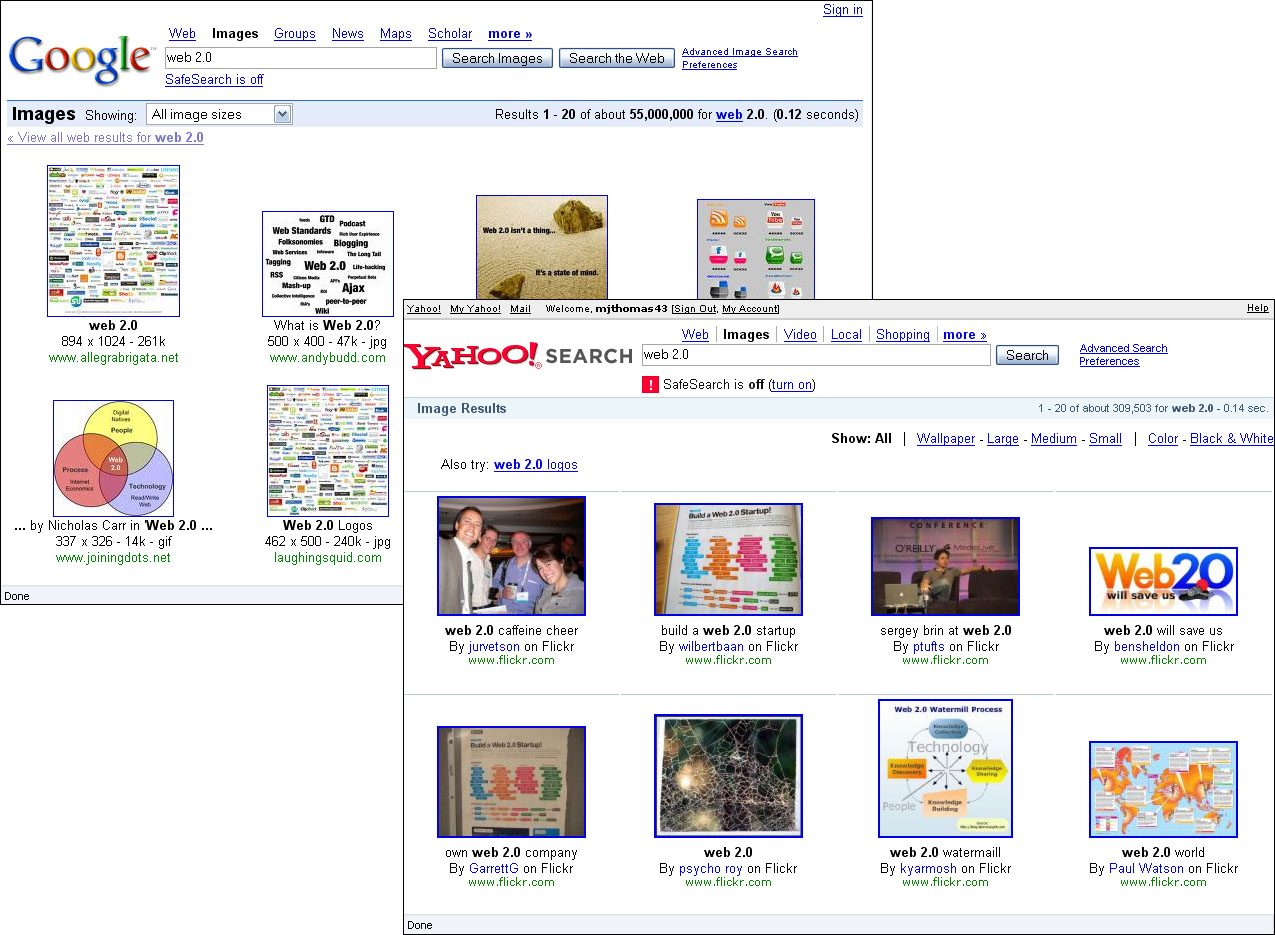
Also, being the de facto graphic designer in my library, I'm constantly looking through Google images (and now Yahoo images) for raw material, ideas, inspirations, and comparisons, and the most important thing I've learned from switching is that these tools even more than the regular web page searching really don't overlap very much. If you're looking for something rather specific and you want as much as you can find, try both, try several.
The only reason everyone is so enamoured with Google is the simple first page and the fact that everyone is talking about it. Word of mouth and visual laziness. Don't get me wrong... it's a great search engine. But there are plenty of great search engines out there, and turning Google into the verb like we have is cutting us off from thinking as quickly about the other options. Although their motto is "Do no evil", no monopoly is ever really good for the consumer. Do yourself (and the rest of society) a favour and shop around, explore, and try other search engines.
Subscribe to:
Posts (Atom)